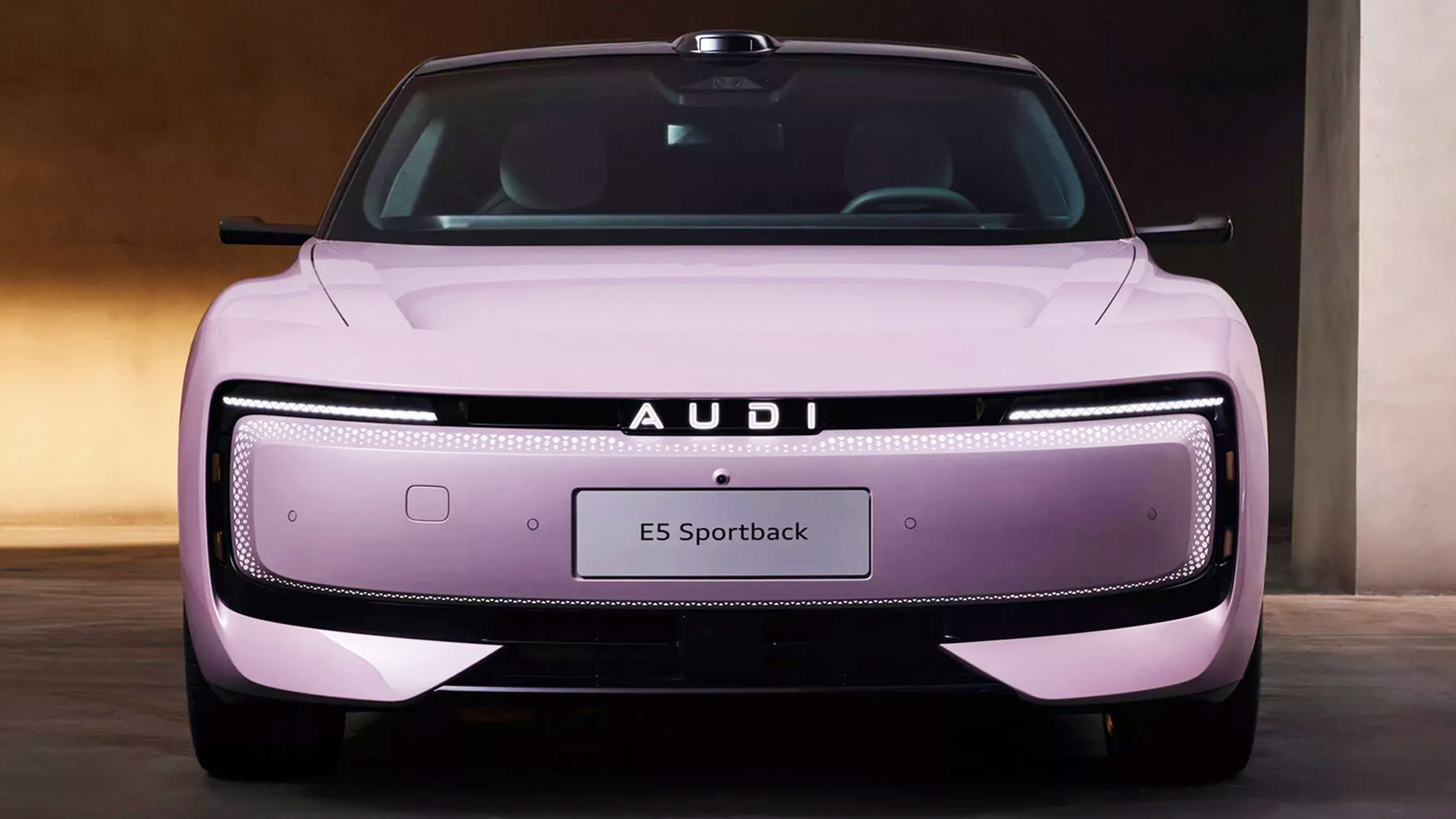
- The all-electric Audi E5 Sportback in China starts at just under $34,000.
- Low battery and energy costs in China help Audi keep prices affordable.
- An equivalent Audi EV in Europe would likely cost at least twice as much.
While Audi has steadily built up its electric range, none of its current EVs have really made a breakthrough in Western markets, aside from the occasional seasonal bright spot. In China, though, the brand may have finally found its moment. The new AUDI E5 Sportback pulled in over 10,000 pre-orders within just half an hour after its debut.
A key reason for its popularity? The kind of price tag you’d expect of a Toyota, not a premium German EV.
Bargain With Big Numbers
In China, the AUDI E5 starts at just 235,900 yuan, which is the equivalent of $33,100 or €28,211 at current exchange rates. That’s a heck of a deal for a luxury car that includes a 76 kWh battery pack, a 295 hp rear motor, and has a claimed range of 384 miles (618 km) under local testing standards.
The upper trims go much further, offering up to 776 hp, while buyers also get a wraparound digital cockpit, and software tailored specifically to Chinese buyers. The interior mixes Alcantara with leather, while the tech list is stacked with features usually reserved for higher-end models.
To put that in perspective, Audi’s least expensive crossover in Germany is the Q2, a sub-compact that begins at €29,000 ($34,000 or 242,500 yuan) for the entry-level 116 hp 3-cylinder TFSI, a price that includes Germany’s value-added tax, or standard sales tax.
More: Audi Launches New AUDI Brand Without Four-Ring Logo In China
Unlike Audi models sold elsewhere, the E5 is exclusive to China and even carries a new badge. Instead of the traditional four rings, the grille simply reads “AUDI,” a deliberate break from tradition designed to appeal to younger, tech-oriented buyers.
Speaking to Germany’s N-TV, industry expert Ferdinand Dudenhöffer described the move as “clever positioning” and a “liberating step,” arguing that the traditional rings carried too much baggage from the past.
Why It Costs So Little

While it might be tempting to chalk up the low sticker price to cheaper wages in China, labor costs account for only around ten percent of total vehicle costs, according to the CAR Institute, N-TV reports.
A slew of other important factors come into play that help AUDI keep the E5 so affordable by Western standards. Battery costs in China are lower, energy is much cheaper, and local production operates with far greater efficiency. On top of that, Germany levies a 19 percent sales tax (VAT), while China applies just 10 percent for regular cars and in some cases zero percent for EVs, depending on price and incentives.
Perhaps most telling, though, is that manufacturers there are willing to operate with margins far slimmer than what German brands typically tolerate. That’s something we rarely, if ever, see in the West. Were a vehicle like the E5 to be produced and sold in Europe, it’d likely cost twice as much, if not more.
Storm Clouds At Home
Back in Germany, the contrast could not be starker. The industry’s struggles are well known, with Audi planning to cut around 7,500 jobs by 2029, Mercedes deep in restructuring, and Porsche rolling back its EV plans. BMW has fared a little better, yet it too has shed thousands of temporary positions.
According to a recent study by EY, Germany’s automotive industry lost more than 50,000 jobs last year, erasing roughly seven percent of its workforce. Compared with pre-COVID levels, the sector employs 112,000 fewer people today. No other domestic industry has suffered losses on this scale.
Future Written In Asia

Against this backdrop, Dudenhöffer argued that Audi’s decision to launch a separate brand in China was both brave and instructive. “Competitors BMW and Mercedes are now under pressure,” he said. “If the price difference becomes too large, customers will switch to Audi.”
He also issued a more general warning. “If the price collapse from China reaches Europe and Chinese models take over here, the Germans need a response,” he said.
“If we don’t learn to build cars that interest customers – with the right price and the right costs – Germany has a problem. We can watch China and say: We won’t get involved in this shameless price war. Or we can say: We need a China strategy.”
Dudenhöffer added that the future of the industry will not be decided in Europe but in Asia. “The vehicles must be built for the customers, not for the employees,” he cautioned. “Without a China strategy, Audi, BMW, and Mercedes are finished globally. And without a China strategy, Germany will also lose its status as an automotive nation.”
John Halas contributed to this story.
#Audis #33K #Chinese #Cheap #Labor